
What Cache County Deed Records Show
The Cache County Recorder indexes every instrument that affects land. It opens the recorded documents to public inspection. A deed names its parties and spells out the interest conveyed. It may also reference a parcel ID, a legal description, an earlier instrument, or a plat. Those links tie a transfer to a specific property. Still, an index entry is only a finding aid. When the exact language matters, read the image itself or ask the Recorder for a copy.
| Deed Type | What It Does | Common Use |
|---|---|---|
| Warranty deed | Recorded transfer; review its terms for the warranties stated. | Sale or other conveyance |
| Quitclaim deed | Conveys the grantor's stated interest; do not infer more than the text gives. | Family or ownership-interest change |
| Executor or administrator deed | May transfer estate property through an authorized personal representative. | Probate or estate settlement |
| Beneficiary deed or survivorship instrument | Can form part of a death-transfer trail. | Confirm against the instrument and any probate file. |
| Mortgage, release, or easement | Records a lien, release, or use right rather than a sale deed. | Encumbrance and land-use research |
Not every recording transfers ownership. A mortgage or deed of trust secures a debt instead. A release or reconveyance can show that an earlier lien was later cleared. Easements, covenants, and subdivision plats shape how land may be used without ever naming a new owner of record. Search Cache County deed records by parcel or by party, then read the instrument type and its description before assuming a filing was a sale.
Cache County's Online Deed Scope
CORE's public property search is not a full deed-image archive. The free tier exposes limited parcel data, while subscriber access adds images and abstracts. The Recorder's office holds that instruments affecting title are open to public inspection. Its official pages do not state the earliest year in the online grantor-grantee index. A first result is not proof of the first deed. An empty search does not rule out an earlier instrument. When the online view falls short, ask the Recorder about a counter search. You can also request a book reference or a copy request. Utah's Government Records Access and Management Act (GRAMA) also provides a request route. It reaches any government office holding records not published online. Give the custodian the parcel ID and party names. Include a date range if known, and the instrument type sought. Older series may sit with Utah State Archives as well as the county office.
Cache County Deed Filing Rules
The Recorder's requirements page spells out document format, signatures, and delivery. A filing must be an original, a certified copy, or a qualifying electronic document. It needs original signatures. It needs a brief title or caption. English text is required, or an accurate translation. The page also fixes rules for paper, margins, recording-data space, page binding, and single-sided printing. Use black ink and include the proper fee. Mail is one way to submit a document. Read the current instructions before sending anything. Once the Recorder accepts an instrument, it cannot be changed. It also cannot be removed from the recorded document. A correction is itself another filing. Check the Cache County recording requirements for exact formatting before delivery.
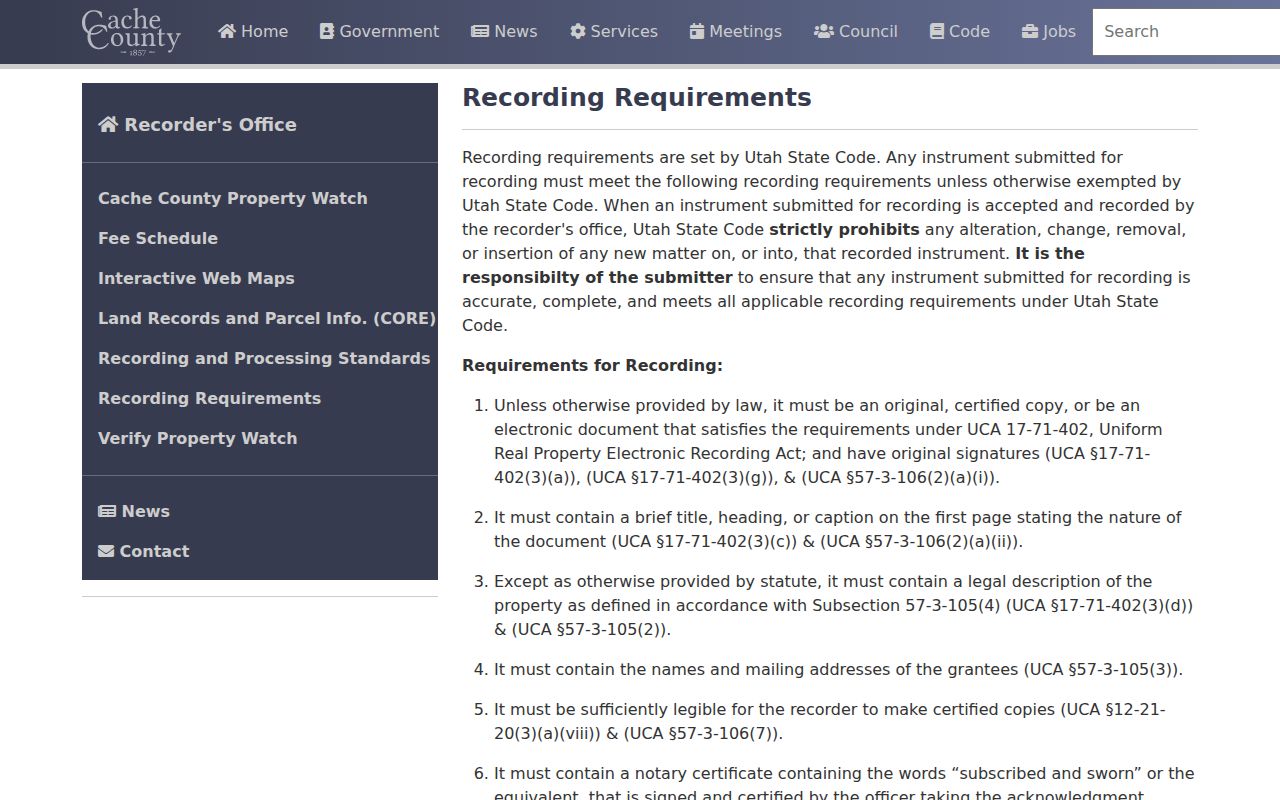
The Recorder's page shown here works as a practical checklist for any document prepared for filing.
Copy and Certification Fees
The published Cache County fee material separates unassisted, staff-assisted, digital, and certified copies. An unassisted copy runs $1 for the first page. Each added page costs 25 cents. Staff-assisted copies cost $2 per page. A digital copy is listed at $1 per document. Certified copies run $5 plus $2 per page. An 18 by 18 inch ownership plat is listed at $8. A recorded 24 by 36 inch plat costs $10. These are copy charges only, not a promise that CORE's public tier includes every image. The Recorder may require payment before furnishing any copy or service. Treat the listed amounts as a guide. Confirm the current schedule before sending money or requesting certification. The official Cache County Recorder fee schedule carries current rates.
Cache County Property Watch Alerts
Property Watch is the Recorder's free alert service for filings that affect a property. Registration accepts a tax ID or an owner, business, or trust name. Once the Recorder processes and verifies a relevant filing, the service sends an email alert. It watches forward only. It does not replace searching for earlier deeds or reading the instrument itself. A parcel number is the focused choice for watching one property. A name works better when the owner of record is a business or trust. After an alert arrives, pull the recorded item and read what it says; the alert alone will not reveal whether the filing changes title or whether a later instrument amended it. The Property Watch registration page shows the exact form fields.
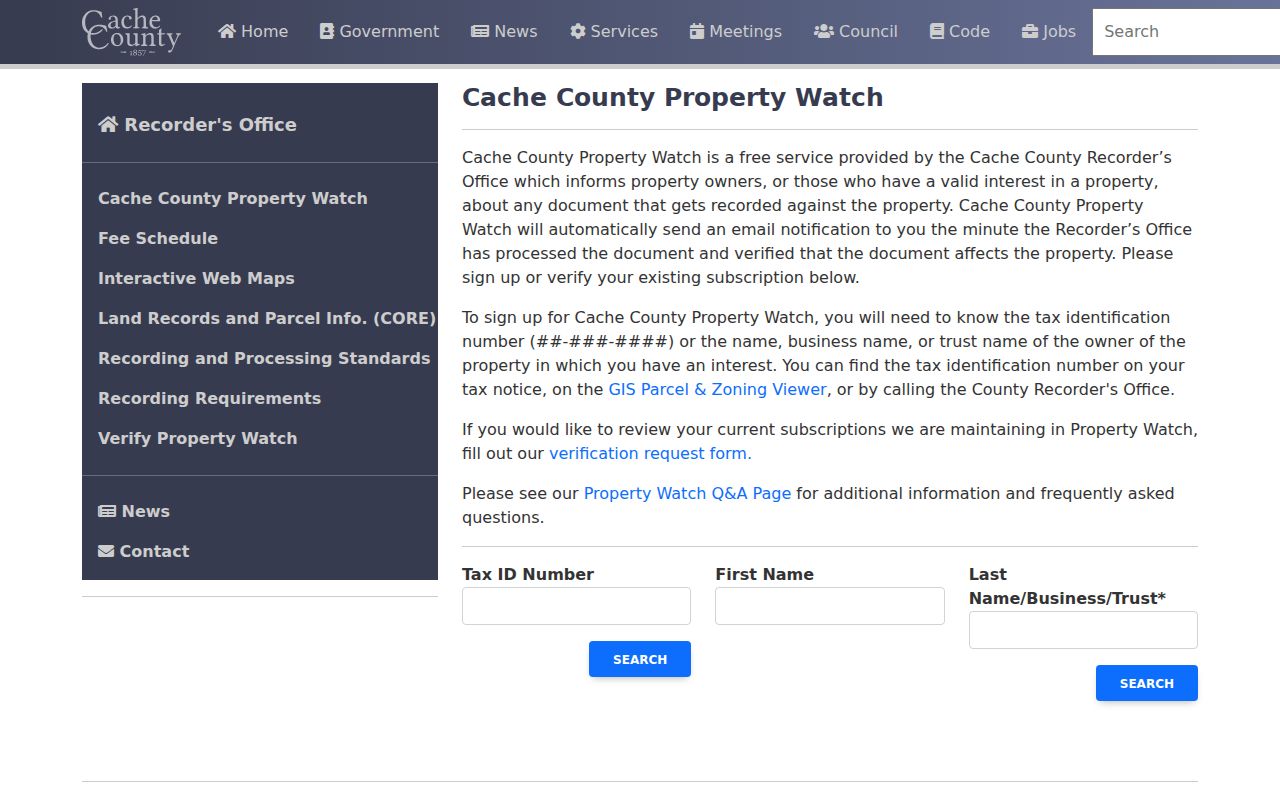
The image shows enrollment controls for a recording alert, not a deed search result.
Liens and Releases in Cache County
A parcel's recorded file in Cache County usually holds far more than deeds. Mortgages, deeds of trust, assignments, and reconveyances sit alongside other instruments. These include mechanic's liens, judgments, tax liens, easements, covenants, restrictions, notices, and plats. Not every instrument conveys ownership. A lien records a claim; a later release, satisfaction, or reconveyance closes that loop. Tie each item to the parcel's legal description and original recording reference before drawing conclusions.
Title disputes sometimes land in court, and a docket can supply useful context. Utah Courts Xchange searches public district and justice filings. Look up records by party, county, case type, and date range. The search caps out at 500 results. District court document images filed since July 1, 2010 are listed at $1 each. Sealed, expunged, juvenile, and child-welfare cases stay out of the results. The court tells one story, but the Recorder still holds the land instrument itself.
Older Cache County Survey Records
For old land history in Cache County, start with the Utah State Archives. Its catalog identifies Cache County Recorder land surveys from 1860 through 1879. The series listings also point to holdings from the Surveyor, Clerk, Court, and Treasurer. Cache County GIS adds another angle. Its Original 1800s Surveys, Historical Parcel, and Historical Roads viewers help connect a current tax parcel to an earlier land shape. They can also suggest an older street alignment.
No official source states the earliest year in the online deed index. Do not guess a cutoff. Work from the current legal description instead. Treat historical parcel and survey material as clues. Ask the Recorder or Archives about older series. A map can point the way. The recorded deed or plat carries the legal description that counts. The Archives processing note names these Cache County land-survey records directly.
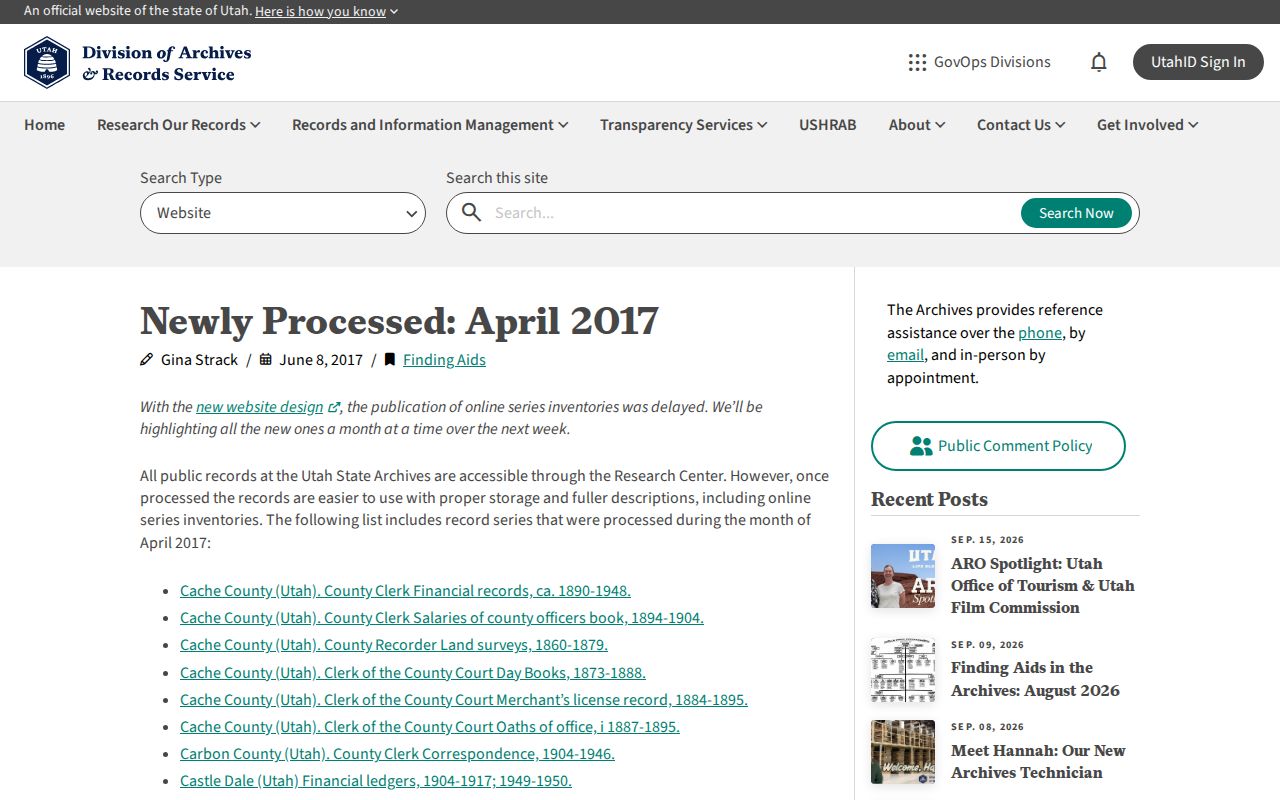
This series is one documented path for older land-history research.
Follow the Cache County Grantor-Grantee Index
A grantor is the party transferring an interest in land. A grantee is the party receiving it. The grantor-grantee index is the backbone of any Cache County title search. Start with the most recent deed you can identify. Note its recording reference and legal description. From there, search the prior party's name to pull up the preceding transfer, and repeat the step backward to build a chain of title. Cache County has published no confirmed online cutoff year or field-by-field inventory for the index, so ask the Recorder to confirm the scope before you rely on it.
- Find the most recent relevant transfer and record its legal description and filing reference.
- Read the grantor and grantee names as written in the instrument.
- Search the previous grantor as a possible grantee on the earlier transfer.
- Repeat and check that the description still matches the same land.
- Grantor
- The party named as transferring an interest.
- Grantee
- The party named as receiving an interest.
- Chain of title
- The ordered trail of recorded instruments tied to land.
- Recording reference
- A book/page or instrument identifier used to find a filing.
Request a Cache County Deed Copy
Identify the instrument in the Recorder's index first. Then request the image or copy that fits your task. Include the parties, parcel tax ID, legal description, and recording reference whenever you have them. CORE subscriber access adds images and abstracts. The Recorder describes public inspection and copy services too. Fees may apply before a copy is released. For mail or counter requests, confirm current payment steps with the Cache County Recorder's office. Confirm delivery steps as well.
Recorded, not guaranteed. The index reports what was filed, and the document image gives its text. It is not a title opinion; older records or unrecorded interests may require separate research.