
What Cache County Tax Records Show
Each office answers a different question. The Assessor and CORE hold the parcel data and assessed market value. The Treasurer's account shows taxes paid or due. Tax Administration handles appeals, relief programs, rates, truth-in-taxation notices, and the annual tax sale. Taxable value is not a sale price. A paid bill does not mean the owner agrees with the assessed value.
| Field | What It Shows | Where |
|---|---|---|
| Assessed / market value | Assessment figures for the selected parcel and tax year | Assessor / CORE |
| Tax ID and situs | Parcel key and property location | CORE / GIS |
| Tax paid status | Paid-tax account lookup by parcel or street | Treasurer |
| Amount due and payment | Current account and payment channel | Treasurer |
| Appeal and relief | Review forms and Tax Administration services | Board of Equalization / Tax Administration |
Notices and bills come from tax administration, not from the market. A buyer today might pay far more. Utah's county appeal material states that residential taxable value is 55 percent of market value when an appeal is prepared. The value-change map adds context only. Read the parcel's own figures and tax year together for the real story.
Find Cache County Tax Status
The Treasurer's paid-tax check takes a parcel number or a street address. Use the parcel number when you know the account. The address route fits a location-only search. CORE carries a Tax Year selector that can pin down the right parcel before the payment check. Keep the result year with your notes, since every figure refers to an account period.
Payment status and the county's published payment paths live on the Treasurer's site. A mortgage company may receive the finalized amount. A notice mailed to a homeowner can carry an “ANTICIPATED MORTGAGE PAYMENT” note. That wording is just part of the tax communication. The note does not change who owns the property or who should watch the account.
Open the official Cache County paid-tax check to begin.
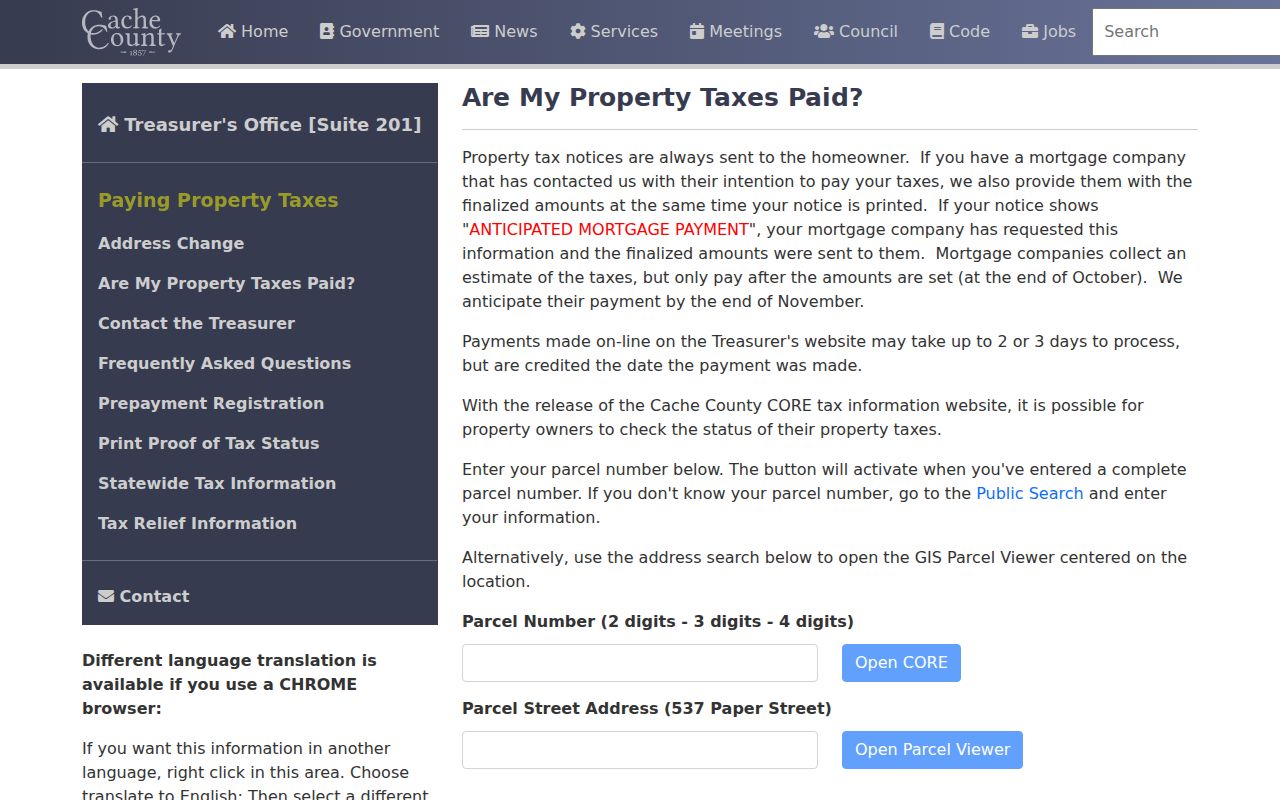
The two lookup paths help connect a known location to its tax payment account.
Cache County Tax Payment Costs
Cache County lists e-check payment as free. A debit card costs $4. Credit cards run 2.5 percent with a $2 minimum. The county describes online, phone, and in-person payment routes, so check the payment page for channel-specific handling before you submit. A two to three business-day processing window is listed, but the transaction date counts as the credit date.
Save the receipt. Put the parcel ID and tax year on it before filing it away. A payment still in process may not appear on a paid-status check yet, and the Treasurer's payment page is the source for current options and charges.
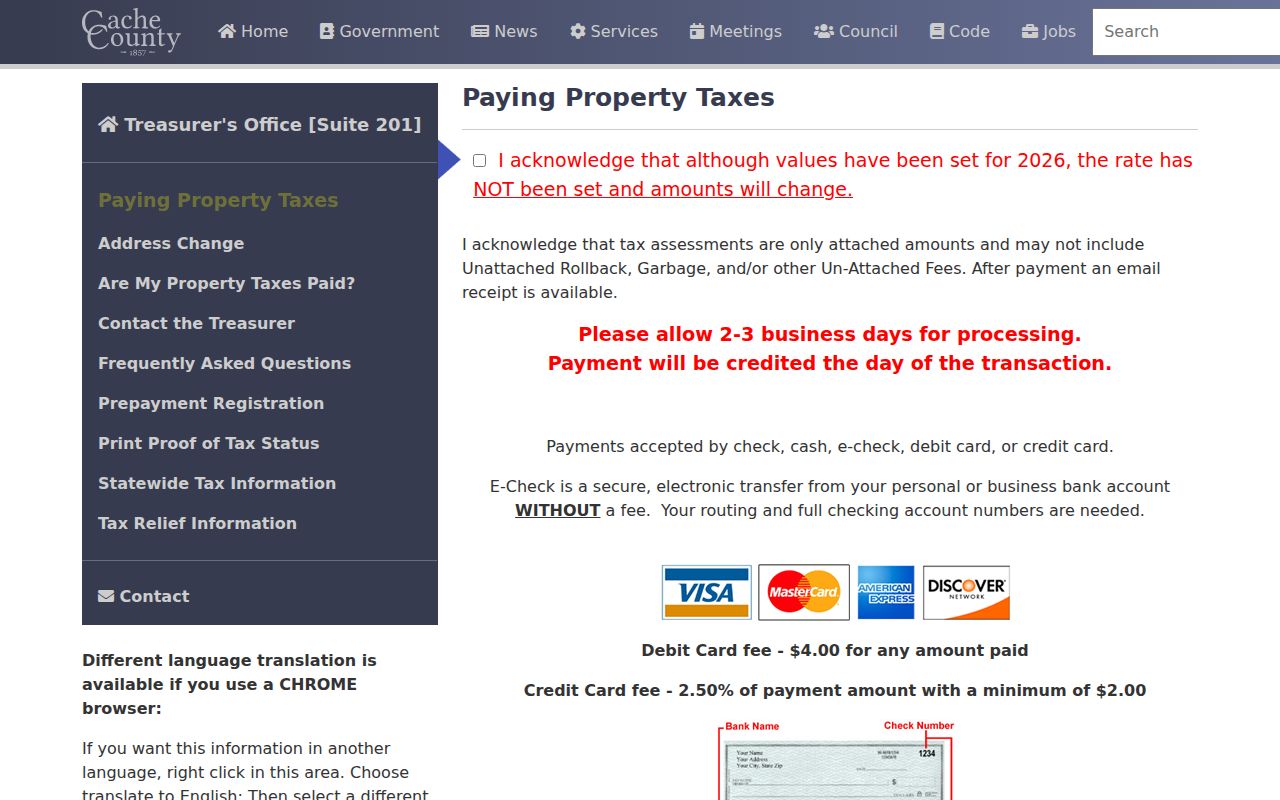
Read the county payment screen before choosing a method.
Cache County Delinquency Dates
The county payment page lays out a late-payment schedule. After November 30, the penalty is 2.5 percent or $10, whichever is greater. Paying by January 31 cuts that to 1 percent or $10, whichever is greater. Interest starts January 1 at the statutory rate the county describes. These are distinct charges. Read the current account and notice rather than assuming one flat late fee.
Confirm the transaction date with the Treasurer near a deadline. Also confirm the posted status. Tax Administration runs the annual tax sale. No sale list, calendar, or redemption page is published. A CORE result alone never shows whether a parcel sits in a sale process.
Look Up a Cache County Tax Bill
Match the bill to the right property first. The parcel card does that job. Then view payment details through the Treasurer's page. A parcel's mailing address can differ from its situs, so compare the tax ID and property address before concluding anything. Assessment questions belong with the Assessor or Tax Administration, not with the payment account.
| Tax Year | Choose the roll year to compare like with like. |
|---|---|
| Parcel | Use the complete tax ID when known. |
| House Number / Street / City | Locate an account from its situs address. |
| Owner or Business Name | Use CORE to find a parcel tied to a named owner or entity. |
- Search the Treasurer's paid-tax page by parcel number or street address.
- Confirm the property and tax year against the CORE parcel result.
- Read the account status and the payment date or amount due.
- Contact the Treasurer about a mismatch or a payment that has not posted.
- Market value
- The Assessor's estimate used in valuation and appeal work.
- Taxable value
- The value basis used for tax calculation under Utah's rules.
- Tax payment status
- The Treasurer's account view of payment or amount due.
- Tax sale
- The annual process administered by Cache County Tax Administration for qualifying delinquent property.
Read a Cache County Value Notice
Keep the assessment year beside each value. The appeal form asks for the Assessor's value and the owner's own market estimate. Supporting evidence can go in with it. Utah's county appeal material uses a 55 percent taxable-value figure for residential property. That percentage belongs to the tax math. It does not mean a home would sell for 55 percent of its assessed market value.
The county's Property Market Value Change Viewer gives geographic context. The parcel assessment still holds the individual value. Nearby parcels can show different map trends. Their use, details, and assessment records may differ. Ground the appeal in the subject property and the evidence submitted on the current form, not just a broad map color.
Appeal a Cache County Assessment
Cache County property owners who dispute an assessment can take the matter to the Board of Equalization. The county sets the deadline at September 15 at 5 p.m., unless a statutory notice rule extends it for the parcel. Confirm the form and procedure each year. Every appeal cycle can bring small changes.
Three submission routes are available: in person, by mail, or by email. The appeal form itself asks for the owner and contact information, the parcel and its location, the Assessor's value, the owner's own estimate, supporting evidence, and a signature. Keep the argument centered on market value. Evidence should back the number you propose.
Tax Administration runs the local process. If the local decision does not settle the question, a separate state appeal route exists. That route stands apart from the county's review.
Appeal window. The Cache County Board of Equalization lists September 15 at 5 p.m. as the local deadline, subject to a later statutory notice rule; verify the date on the current notice and form.
See the county's Board of Equalization appeal instructions before filing.
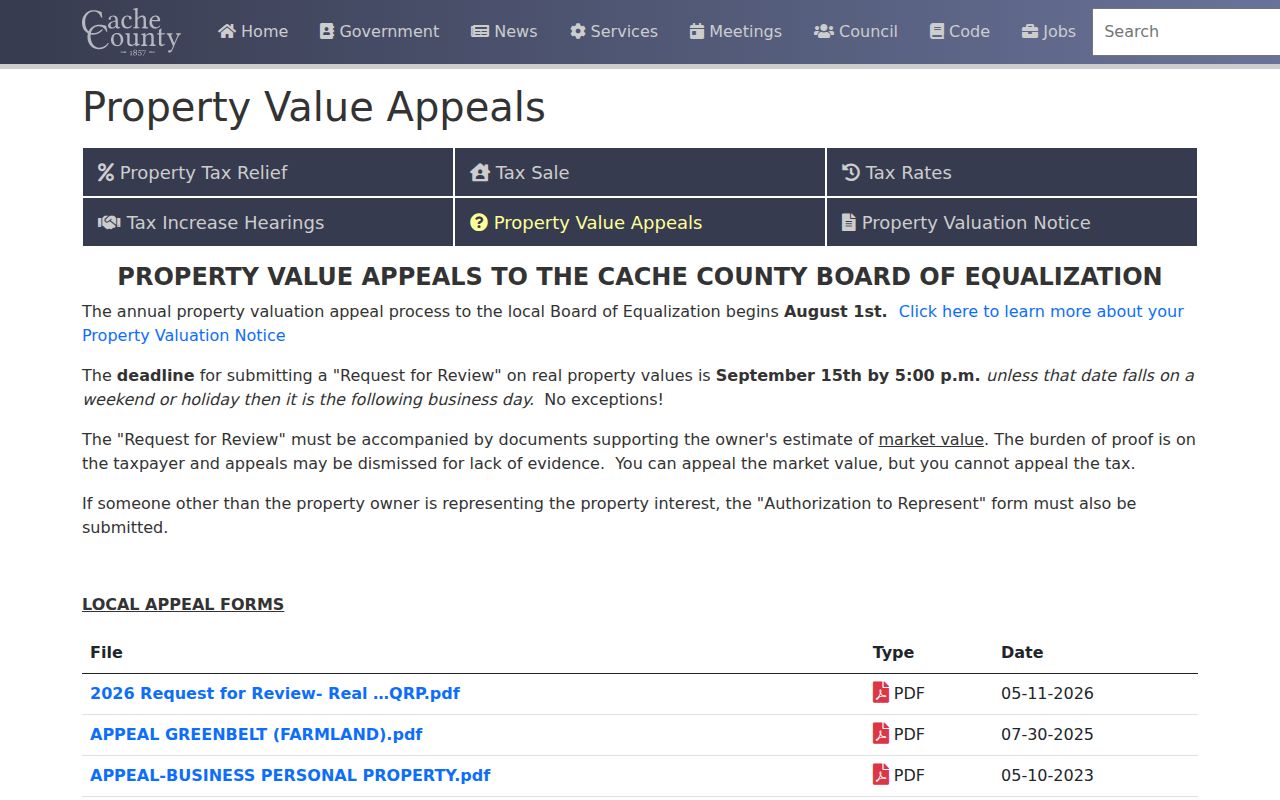
The county page is the source for the current submission channels and deadline.
Cache County Relief and Tax Sale
Tax Administration in Cache County oversees property-tax relief and exemption programs. It also handles the annual tax sale, valuation appeals, greenbelt rollback, tax rates, and truth-in-taxation notices. No single published list names every program's eligibility rules. Ask Tax Administration how the rules apply to a specific account. Use the county's current forms rather than a general label.
The annual tax sale is its own process. A routine tax bill lookup will not cover it.
A property record may show a delinquency entry. But it does not reveal every sale step or redemption deadline. Tax Administration posts no complete sale calendar and redemption instructions online. Verify any sale-related question with that office before acting.